Revolutionizing Early Education: The Strategic Impact of Outlined Dashed Tracing Fonts
In the rapidly evolving landscape of educational technology and content creation, the tools we use to bridge the gap between abstract concepts and tangible skills are becoming increasingly sophisticated. Among the most effective yet often overlooked innovations in this space are Outlined Dashed Tracing font collections. These are not merely typefaces; they are pedagogical frameworks embedded into vector graphics, designed to streamline the teaching of letter formation, handwriting, and fine motor control. For professionals, creators, and educators, understanding the utility of these fonts offers a strategic advantage in producing high-quality, interactive learning materials that meet the modern demand for structured, hands-on education.
Understanding the Core Concept: What is Outlined Dashed Tracing?
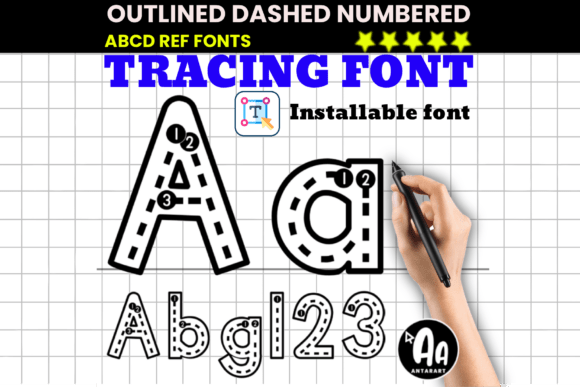
At its foundation, Outlined Dashed Tracing refers to a specific typographic style where letterforms are rendered as hollow outlines with dashed or dotted interiors. This visual cue transforms a static character into an interactive guide. However, the sophistication of these collections lies in their variations. The ABC Outline Dashed Dotted Numbers style, for instance, focuses on creativity. It provides hollow shapes that students can not only trace but also color, merging literacy practice with artistic expression. This dual-purpose approach is critical in early childhood education, where engagement is the primary driver of retention.
Taking this a step further, the Outlined-Dashed Numbered version introduces a layer of explicit instruction. By incorporating numbered stroke orders within the dashed interior, these fonts guide the learner through the muscle memory required for proper writing technique. This method moves beyond simple imitation; it teaches the process of writing. For content creators, this distinction is vital. It allows for the creation of resources that cater to different stages of the learning curve—from simple recognition and coloring to complex motor sequencing.
The Pedagogical Shift: Why Structure Matters More Than Ever
The modern educational landscape is witnessing a significant "return to basics" in literacy instruction, driven by cognitive science research emphasizing the link between handwriting and reading comprehension. Parents and educators are increasingly aware that typing cannot replace the neural development stimulated by manual writing. Consequently, there is a growing market demand for printable practice sheets and custom tracing worksheets that offer more than just blank lines.
Outlined Dashed Tracing fits perfectly into this shift. It addresses the changing expectations of parents who seek structured, evidence-based learning tools. Unlike free-form writing, which can lead to the reinforcement of incorrect habits, these fonts provide a safety net of guidance. They support the development of fine motor control and letter recognition simultaneously. For entrepreneurs in the educational resource space (often referred to as Teacher-Authors on platforms like Teachers Pay Teachers), offering products that utilize these fonts signals a commitment to quality and effectiveness. It aligns your product with the "Science of Reading" and structured literacy movements, which are currently dominating educational discourse.
Practical Applications for Creators and Marketers
The versatility of a comprehensive Outlined Dashed Tracing font collection extends far beyond standard worksheets. Because these collections typically include uppercase and lowercase letters, numbers 0–9, and common symbols, they provide a complete toolkit for a variety of creative and business applications.
For instance, in the realm of classroom décor, these fonts allow for the creation of bulletin board letters that are not only decorative but also functional. A bulletin board featuring dashed lettering invites interaction, turning passive wall art into a learning station. Similarly, for editable student name templates, the dashed format allows for personalization that is developmentally appropriate. Teachers can generate a "name plate" for every student where the name is presented in a traceable format, helping children learn to write their own identity—a crucial milestone in early education.
Moreover, the application of these fonts in back-to-school reviews cannot be overstated. As students return from breaks, "summer slide" is a common concern. Tracing worksheets generated from these fonts offer a low-stress, high-engagement way to reacquaint students with the mechanics of writing. For freelancers and marketers, this presents a seasonal opportunity to create "Summer Bridge" or "Back-to-School Bootcamp" bundles that address specific pain points for parents and teachers.
Workflow Efficiency and Technical Compatibility
From a production standpoint, the value of these fonts lies in their efficiency. Traditional methods of creating tracing worksheets often involve manually drawing dashed lines or using complex vector software to outline text. This is time-consuming and difficult to scale. By contrast, an Outlined Dashed Tracing font allows creators to type directly into standard word processors or design software and instantly generate print-ready tracing materials.
This compatibility is a game-changer for content creators. Being fully compatible with programs like Microsoft Word, PowerPoint, Google Docs, and Adobe Illustrator means that the barrier to entry is virtually nonexistent. You do not need to be a graphic designer to produce professional-grade educational resources. This democratization of design tools empowers educators to create alphabet lessons, handwriting books, and interactive worksheets with minimal technical overhead. The workflow shifts from "designing" to "typing," drastically reducing production time and increasing the potential for output and revenue.
Addressing Market Needs and Future Trends
While these fonts are based on traditional school handwriting styles, their application is forward-looking. The trend toward personalized learning is accelerating. Parents and teachers are looking for resources that can be tailored to individual needs—whether that means focusing on specific letters, numbers, or even custom words that align with a student's interests (like sight words or vocabulary lists).
The Outlined Dashed Tracing approach facilitates this personalization. By using these fonts, creators can easily generate custom content without hiring a graphic artist for every new worksheet. This agility allows businesses to respond to market trends—such as the popularity of specific themes or curriculum changes—almost instantly.
It is worth noting the specific technical considerations for a global audience. While these collections are comprehensive, they typically follow the traditional English alphabet and common symbols. Note: These fonts generally do not support Spanish characters or accented letters. This is a critical detail for creators targeting bilingual markets or ESL (English as a Second Language) learners. Understanding these limitations allows for better product positioning and helps manage customer expectations, ensuring that the resources are marketed effectively to the appropriate demographic—specifically, those focusing on English-language primary education.
Conclusion: A Tool for Confidence and Competence
Ultimately, the adoption of Outlined Dashed Tracing fonts is about more than just aesthetics; it is about building confidence. For the child, seeing the path laid out clearly—whether through simple dashes or numbered strokes—reduces the anxiety associated with learning to write. It transforms the daunting task of forming letters into a manageable, step-by-step process.
For the professional creator or educator, these fonts represent a bridge between pedagogical theory and practical application. They allow for the creation of interactive, engaging, and structured resources that align with current educational best practices. Whether you are developing a comprehensive handwriting curriculum, designing classroom decorations, or offering editable templates for busy teachers, integrating Outlined Dashed Tracing into your workflow ensures that your products are not only visually appealing but also functionally superior. In an era where educational quality is under the microscope, providing tools that genuinely support learning outcomes is the most valuable business strategy of all.